
Business coaching on iPhone
An AI mentor
for solo founders.
Talk through a business decision, choose a useful next step, and return with what happened.
Available for iPhone
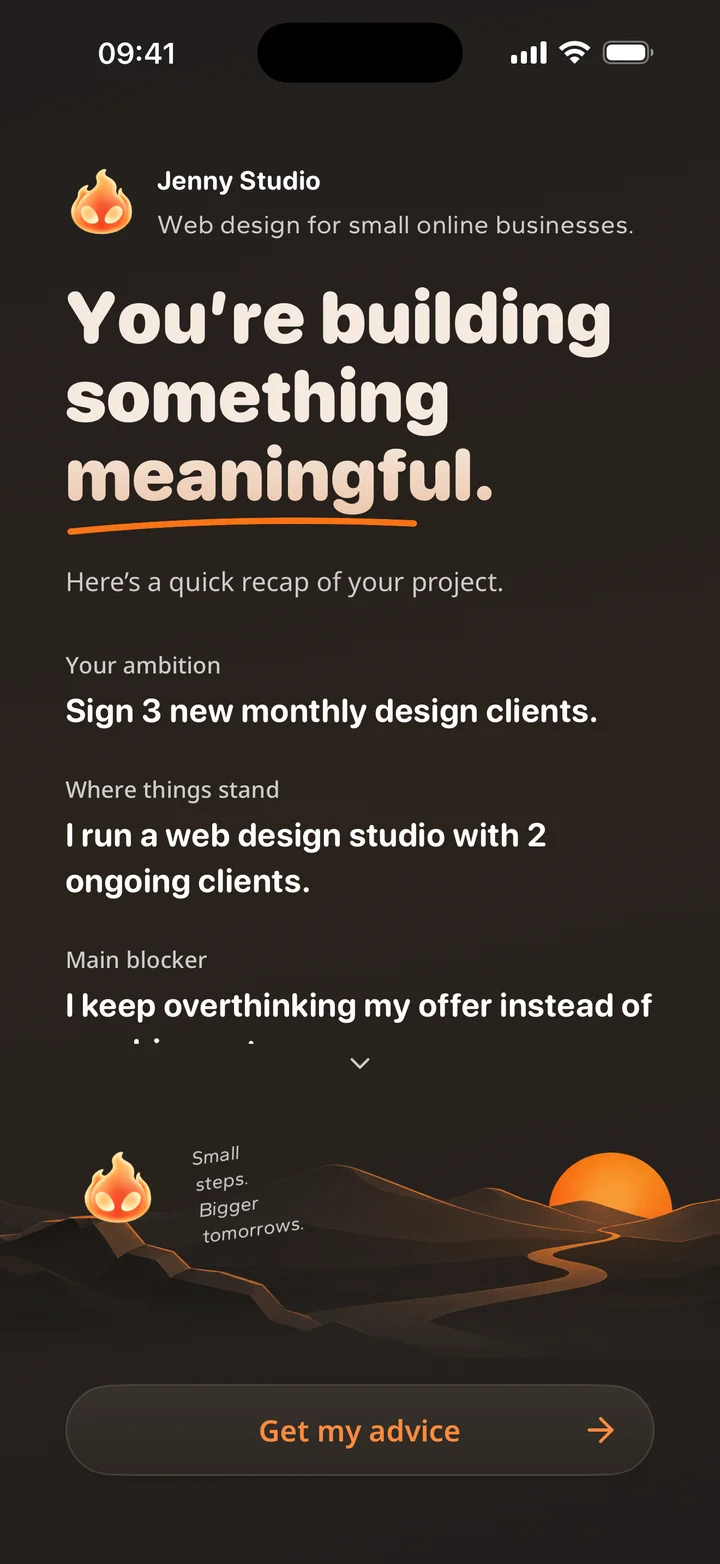
Real app screen with an illustrative business.
Choosing business support
AI or human mentor: which fits your decision?
Use AI to organize a decision you can verify yourself. Choose a human mentor when relevant experience, detailed feedback, or a working relationship is central. Neither replaces talking to customers.
| Your situation | How to use an AI mentor | What to ask a human mentor |
|---|---|---|
| You need a realistic next step. | Lay out options using your goal, available time, and evidence. Ask which assumptions could change the choice. | Ask them to challenge your priorities and agree what you will report back. Set a check-in schedule that works for both of you. |
| You are changing an offer or price. | Compare scenarios using your own costs and customer notes. Verify calculations and any claimed market benchmarks. | Look for experience selling or delivering similar work. Ask them to examine your scope and explain where their experience may not apply. |
| You need industry judgment or introductions. | Prepare questions and list what you need to learn. An AI answer is not firsthand operating experience or a personal referral. | Check their relevant background and ask about a specific introduction. Access to their contacts is never guaranteed. |
| You need to know whether customers will buy. | Turn assumptions into questions to test with buyers. Generated customer reactions are not evidence of demand. | Ask them to critique your test and share relevant experience. Their enthusiasm does not establish what your customers will pay. |
Need a human mentor on a small budget? SCORE offers free mentoring for aspiring and established owners of US-based businesses. Look for experience relevant to your question.
See how SCORE mentoring worksAI can produce confident but incorrect answers, including faulty reasoning and citations. Open sources and check the numbers before relying on a recommendation.
Read NIST’s explanation of this risk (PDF, section 2.2)The coaching workflow
Choose a step. Learn from it.
The useful part of coaching is what happens after the conversation. Bring back real results so the next step reflects your business.
-
Bring one decision and its context.
Describe your business, the outcome you want, and where you are stuck. Talk or type. Include the evidence and constraints that should shape the next step.
-
Choose an action you can actually take.
Use the guidance to narrow the work. Check its assumptions, choose a finishable action, and decide what result you will bring back. You make the decision and do the work.
-
Return with what happened.
Choose a check-in time and allow notifications if you want reminders. Report what moved, what did not, and what you learned. Use that context to choose the next action.
A hypothetical founder example
A business mentoring question you can adapt.
Use this hypothetical example to prepare a question and check the answer. It is not an app transcript or a customer result.
-
The decision
Four hours to learn what buyers need.
A freelance designer wants two new clients within six weeks. She can deliver only one small pilot at a time. She has four hours this week and three past clients she can contact, but has been spending her time revising her website.
-
The question
Ask an AI business mentor to compare two options.
“I design websites for local service businesses. I want two new clients in six weeks, but can deliver only one small pilot at a time. I have four hours this week and three past clients I can contact. Should I rewrite my homepage or ask those clients about their current needs? Compare the tradeoffs, flag missing evidence, and suggest one test within four hours. Do not assume a sale.”
-
Review the answer
Check whether the recommendation fits.
A daily content schedule does not answer this choice. Check that the advice respects the four-hour limit and one-pilot capacity. If it assumes the website is the problem, ask what evidence supports that. Leave invented customer demand or predicted sales out of the decision.
-
The test
Bring back evidence from real conversations.
She chooses to ask the three past clients about their current needs. On Friday, she records who replied, the problems they described, and whether a scoped pilot could help. No replies leave demand unknown. She uses the results to choose a follow-up, refine the offer, or test a different way to reach buyers.
Practical business lessons
Work through the task in front of you.
These lessons include worked examples and templates you can use independently.
When you need customer evidence
Prepare neutral questions and learn how people handle the problem today.
Run a customer discovery interviewWhen you need your first customers
Choose a channel, build a small prospect list, and test a focused offer.
Find customers without an audienceWhen the offer needs clearer boundaries
Define the scope, account for delivery costs, and set a price you can explain.
Price an offer and handle revisions
Before you start.
How do I get useful advice from an AI business mentor?
Name one decision, the options you are weighing, what you have tried, and your time or delivery constraints. Ask for tradeoffs, missing evidence, and one small test. Check that the answer uses your actual facts before acting. A confident recommendation is not evidence that customers will buy.
Does Mentor find customers or run my business for me?
Mentor provides guidance from the context you share and supports daily follow-through. You still gather customer evidence, contact prospects, deliver the work, and judge the results. A suggested action is not proof that demand exists.
What should I report at a daily check-in?
Report the action you completed, what happened, and any blocker or new constraint. Keep actions and outcomes separate: sending a proposal is an action; a customer accepting it is an outcome. Use both to decide what should happen next.
Can an AI mentor replace a human business mentor?
Use AI to prepare questions, organize the context you provide, and review next steps. Choose a human mentor when relevant operating experience, detailed feedback, or a working relationship matters. You can combine both, but verify the advice against your own evidence. Use a qualified professional for legal, tax, or regulated financial decisions.